Reintroducing Uzbek Cinema: A Dialogue with Elmira Hasanova
for Ayneh Journal
Written by Guzal Koshbahteeva*****
Rarely addressed in global scholarship, Uzbek cinema has remained comparatively underrepresented in international film discourse and festival circulation (Naficy, 2001; Taubkin, n.d.). Even though it covers more than a century of artistic output, it has often been approached through fragmented or partial narratives. This absence, however, is not due to a lack of complexity. On the contrary, Uzbek cinema emerges from a complex history and cultural experiences that have helped create films with an emphasis on poetic expression, emotional restraint, and technical experimentation. The industry has lived through four key stages: early ethnographic film, Stalinist propaganda, the mid-century "New Wave," and, more recently, a complex blend of commercial productions and state-supported initiatives (Taubkin, n.d.).
At every stage of the film industry's evolution, film directors shaped their work in response to the institutional environment surrounding them, and at the same time, persisted in finding their own voices. To name a few early pioneers of cinema in Central Asia, Khudaibergen Divanov is remembered as one of the first. In 1913, he documented scenes of pre-Soviet life on film. His images now stand as one of the few surviving pieces of footage from that era. Later, during the Soviet Government, cinema began to serve as a tool of ideological control; despite this, filmmakers such as Suleiman Khojaev applied the medium to resist the dominant ideologies, often at a personal cost. Next, in the post-Stalin era, a brief flourishing of creativity allowed comedy and fantasy to emerge as favored genres. Films such as Maftuningman (1958), The White Camel (1974), and Abdulladzhan, or Dedicated to Steven Spielberg (1991) experimented with hybrid genres and styles (Taubkin, n.d.). The films expressed broader social pressures and carefully implanted critique within state-sanctioned frameworks.
Following the collapse of the Soviet Union, Uzbekistan's film culture underwent a period of redefinition. The cinema industry and its filmmakers began to engage with new emerging production contexts and expanded thematic approaches.
Today, Uzbek filmmakers are increasingly turning to history, myth, memory, and pre-Soviet imagery, where looking back becomes a way of moving forward. History is viewed less as a completed event and more as an ongoing process. The question, then, is not about defining the Uzbek identity, but about how cinema brings an existing identity into a contemporary form. Subsequently, it points to a generational question: how to connect inherited memories with everyday life experiences, and, moreover, how to understand the past in light of the present.
Furthermore, within this ongoing engagement with the past, younger voices begin to raise new questions shaped by the understanding that history requires interpretation. The past becomes meaningful when it finds its voice in the present. For today's filmmakers, the challenge is to tell the past in a way that clearly speaks to the present. Therefore, this gap between generations, between memory and imagination, becomes a condition for filmmakers to work with.
In order to understand the industry and its developments from within, Ayneh spoke with Elmira Hasanova.
She is a [screenwriter/filmmaker/lecturer] who has been contributing to the Uzbek film industry for over five decades. Her reflections offer a perspective on the changes, enduring challenges, and creative directions that are shaping contemporary Uzbek cinema.
𓂃 ོ𓂃
[◉°]
[◉°]
Elmira Hasanova’s animated works include Oshiq Garib, Simurgh, Shiroq, Farhod and Shirin, The Flying Horse, and several other titles. Her feature films include Visol (2013), Oh, Salima, Salima (2017), Adventure in the Steppe (2025), Desire (Nafs, 2010), Strike (Zarb, 2013), and The Falcons (Shunqorlar, 2016). Her screenwriting work includes the television series Family Wars (2012), Jibek (2014), Asil Arman (2016), Autotest (2016), Land of Kindness (2017), Secret of the Heart (2018), and Khokim-Buva (2022).
[◉°]
[◉°]
Guzal Koshbahteeva: Could you please introduce yourself to our readers and briefly describe your profession and experience in the film industry?
Elmira Hasanova: Elmira Hasanova is a screenwriter, film lecturer, director, and producer who has created several film projects and numerous television programs. Looking back, I have “lived cinema” for more than 50 years, because I became passionate about this art form in my teenage years, and by the age of 14, I knew with absolute certainty that I would study at VGIK in Moscow. Since then, I watched every film released in theaters in the USSR, bought every film magazine, and my family and friends always knew that the most precious gift for me would be a set of postcards with movie stars (at that time, special sets of postcards featuring favorite cinema idols were produced).
Guzal: If you recall the very beginning, what was the first image that made you feel the power of vision and perception?
Elmira: The film that made the strongest impression on me was Michelangelo Antonioni’s The Night (1961). I still marvel at how this complex black-and-white film about the difficulties of family life, the fading of love, and alienation could touch the mind and heart of a little 14-year-old girl. After crying all night, by morning, I knew for sure that I would apply to study film at the world's best film school — VGIK.
Guzal: Would you say that cinema was a conscious choice for you or something inevitable, something that found you?
Elmira: Of course, it was a conscious choice. I could not imagine any profession or field of activity other than cinema. I must admit that I did not get into the film institute immediately. It took four attempts, and my parents were terribly upset by my stubbornness. However, I couldn't think about anything else.
Guzal: Could you share some of your favorite Uzbek films?
Elmira: As a child, I loved all the films of Shukhrat Abbasov, especially You Are Not an Orphan (1963) and Tashkent, the City of Bread (1968). I was deeply impressed by Ali Khamraev’s film The Seventh Bullet (1973), and I even wrote my diploma paper on the topic “Western in Central Asia,” in which I analyzed his film. I also greatly admire Yalkin Tuychiev’s film Ilova, Postscriptum (2010).
Guzal: How does your storytelling reflect both your inner perspective and the broader cultural world you come from?
Elmira: You know, when I write scripts, I inevitably immerse myself in our daily life and the particularities of Uzbek culture and mentality. The story, in any case, ultimately emerges from our experiences, themes, and characters that come from our people. But good ideas—they’re universal, and they resonate with audiences everywhere.
Guzal: Having experienced Uzbek cinema both as a young viewer and as a professional filmmaker, you have witnessed its evolution firsthand. For many outside of Uzbekistan, national cinema remains a mystery or a memory; it is often reduced to Soviet visual grammar or folkloric motifs. How would you describe Uzbek cinema today, in its current form?
Elmira: Uzbek cinema today is a very vibrant and heterogeneous tapestry. Some of its directions and trends contradict each other: on one hand, there are commercial productions. On the other hand, very profound auteur films continue to emerge. They may not appear frequently, but they do appear. Recently, I was particularly pleased by Umid Khamdamov’s film Issyk Non/Hot Bread (2018) and Yalkin Tuychiev’s 2000 Songs of Farida (2020).
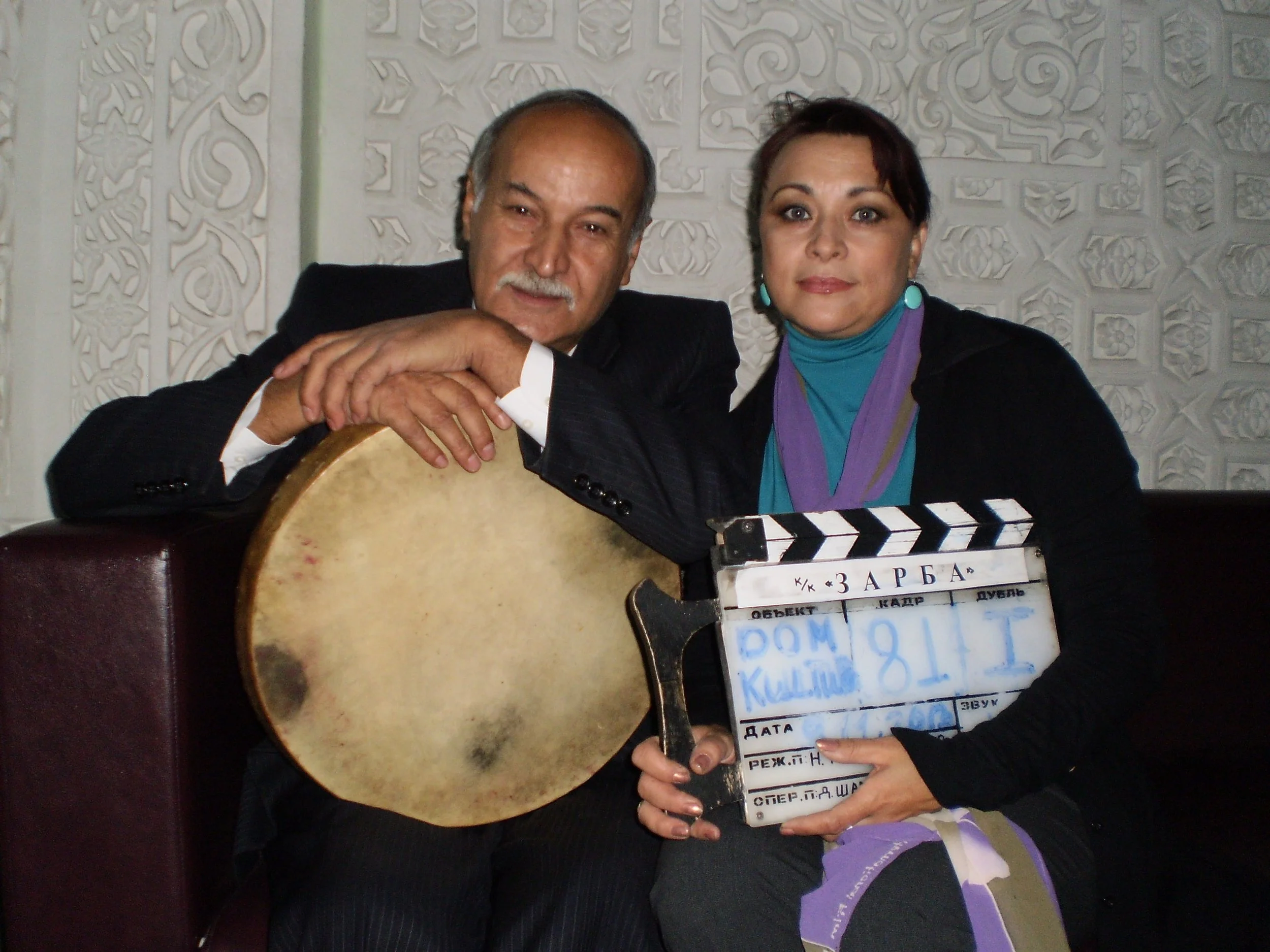
Elmira Hasanova on the film set of Zarb, (2014) with Bakhtiyar Kasymov. © All rights reserved.
Guzal: Thinking about your experience and the evolution of Uzbek cinema, what does the expression ‘Uzbek cinema’ mean to you personally? Is it a language, an institution, a geography, or perhaps a unique feeling or worldview?
Elmira: For me personally, the concept of ‘Uzbek cinema’ is a conglomerate of profound films and the great names of directors, actors, and screenwriters. I hope that we will still see interesting and innovative films created in our film studios.
Guzal: If you could identify something that belongs uniquely to Uzbek cinema, what would that be, and why?
Elmira: Perhaps this may sound lofty, but I have always loved the films that reveal the beauty of the ordinary Uzbek people — their particular humor and kindness. When filmmakers manage to capture the ‘unique spirit’ of our problems and our people and express it on the cinematic canvas, it is always a great celebration for the soul.
Guzal: For readers unfamiliar with Uzbekistan, could you describe the current structure of the film industry? How are films financed, produced, and distributed?
Elmira: In Uzbekistan today, film production is divided into two segments: films funded by private investors, sponsors, and large advertisers—these are the so-called private or commercial films—and films that receive substantial funding from the state and are created by a government commission. The former are typically light-genre productions aimed at broad audiences, while the latter—state-funded films—are usually focused on historical subjects or themes considered important for education and cultural development.
Just a few years ago, we took pride in our theatrical distribution: in major cities, private cinemas were opening, and in Tashkent alone, many screening halls were drawing strong box office numbers. Today, unfortunately, audiences have largely moved to streaming platforms, preferring to watch films at home. As a result, production companies have emerged that are ready to invest in content specifically for digital platforms.
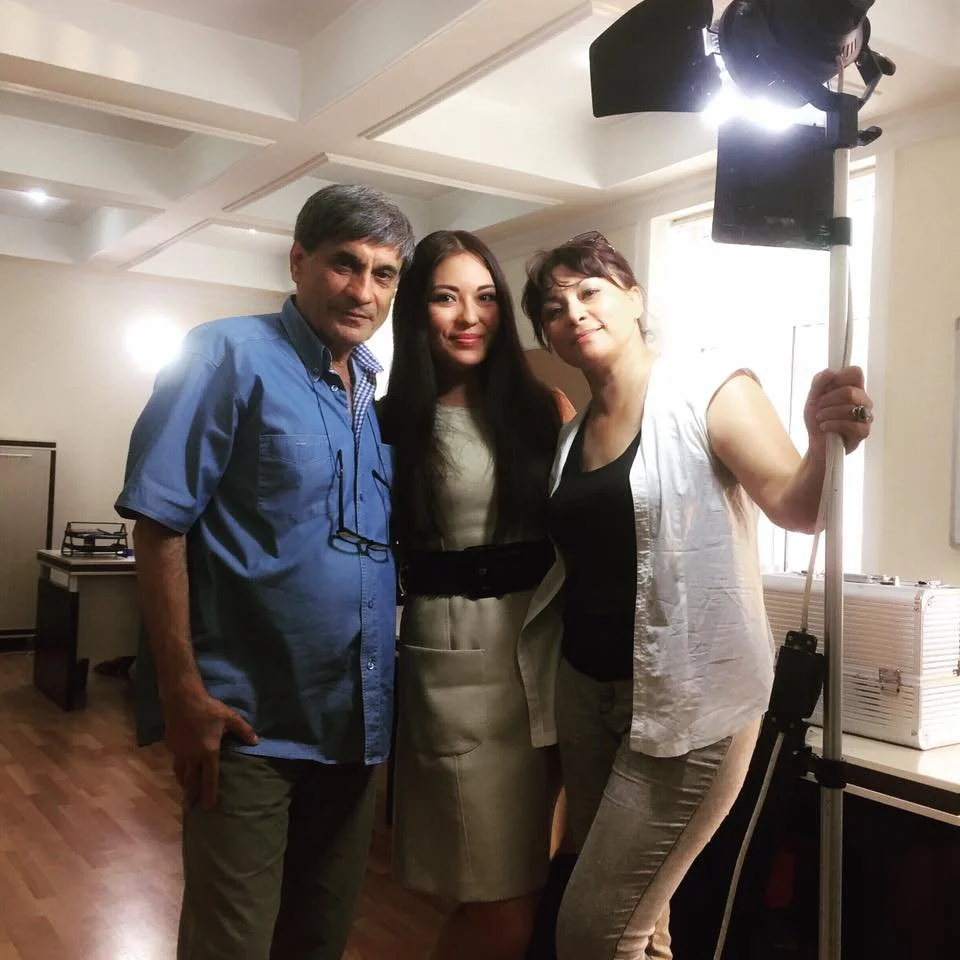
Elmira Hasanova, film set. 2016. © All rights reserved.
Guzal: When Uzbek films make it to international festivals, they are often viewed through the lens of “exotic” or “authentic.” How do you personally feel about foreign critics interpreting your work in this way?
Elmira: When an Uzbek film is selected for an international film festival, it’s a huge celebration for the entire country. Of course, every festival has its own selectors and its own goals. But I believe that what’s truly valued—first and foremost—is interesting, distinctive filmmaking… and only then comes the notion of “exotic.”
Guzal: If we talk about the work process. What role do collaboration and collective work play in the Uzbek film industry, both domestically and internationally?
Elmira: Between 2019 and 2021, a series of reforms were implemented in the film sector. The National Center for the Development of Cinematography strengthened its activities, establishing a system of collective discussion and project selection that included councils, expert committees, and pitching sessions. Naturally, this has encouraged screenwriters, directors, and producers to work in teams.
Over the past 15 years, co-productions with Russia, Belarus, Kazakhstan, and Turkey have become more active. These collaborations resulted in films such as The Uzbek Woman (2023) by film director Akbar Bekturdiev, about an Uzbek female sniper during World War II; Kazbek by film director Iskandarov, which tells the story of a hero of a partisan unit in Belarus; and the fairy-tale film The Magic Peri by film director. F. Makhmudov and Mendirman Jaloliddin (2021), a Uzbek–Turkish historical project.
The revival of the Tashkent International Film Festival in a new format has transformed it into a platform for signing cooperation agreements, presenting projects, and establishing producer networks. This includes initiatives such as the Cinema in 5 Days laboratory, where international teams collaborate to produce films within a limited time frame.
Guzal: In this context, I’d like to ask about creative possibilities today. Are there genres or formats today that provide Uzbek directors with a larger space for creative exploration?
Elmira: Perhaps the most open and flexible field is short filmmaking. This is the cinema of young and independent filmmakers—often funded by personal resources—where a high degree of formal experimentation is possible.
Short films serve as an important platform where ideas are less constrained by market demands, allowing filmmakers to explore social themes and ideas within a more flexible creative format.
It is no coincidence that short films frequently succeed at international festivals—for example, the works of Shokir Kholikov, Tea (2020) and Sunday (2023), as well as Cholyk (2025) by Jamoliddin Kuziboev.
Guzal: From your perspective, which aspects of the Uzbek film industry have remained most consistent over time?
Elmira: Contemporary Uzbek cinema has not severed its connection with the past. It continues to engage with national history, cultural identity, the poetics of everyday life, and folklore—now expressed through the language of modern drama, historical film, and melodrama. Even mainstream and television cinema incline toward stories about family, moral choice, and social cohesion. The same values that once shaped the identity of classic Uzbekfilm productions.
Guzal: You're currently teaching film to young people. What are your observations? What can you say about the new generation and their desire to make films?
Elmira: Yes, I’m currently teaching screenwriting at my alma mater — the Tashkent branch of VGIK. We have many students enrolling in programs for acting, screenwriting, directing, and producing. It’s always a joy to see their enthusiasm — the spark in their eyes, their energy, their readiness to jump onto a film set tomorrow.
Many young students are at the beginning of their journey of learning and forming a relationship with cinema as well as the habit of sustained reflection that comes with experience and guidance.
𓂃 ོ𓂃
Ayneh extends its sincere gratitude to Elmira Hasanova, who kindly shared her experience of the Uzbek film industry. The platform hopes this piece will resonate with audiences and bring greater attention to both the artist and the Uzbek cinema industry.

Elmira Hasanova is a contributing artist to this publication and an award-winning filmmaker. She is a laureate of the Golden Knight International Film Festival in Russia, a recipient of Japan’s NHK Prize for the documentary Yonayotganlar (The Burning Ones), and the winner of Kazakhstan’s Altyn Tumar Award for “Best TV Series of the Year” for Asil Arman (Astana TV).
References: